
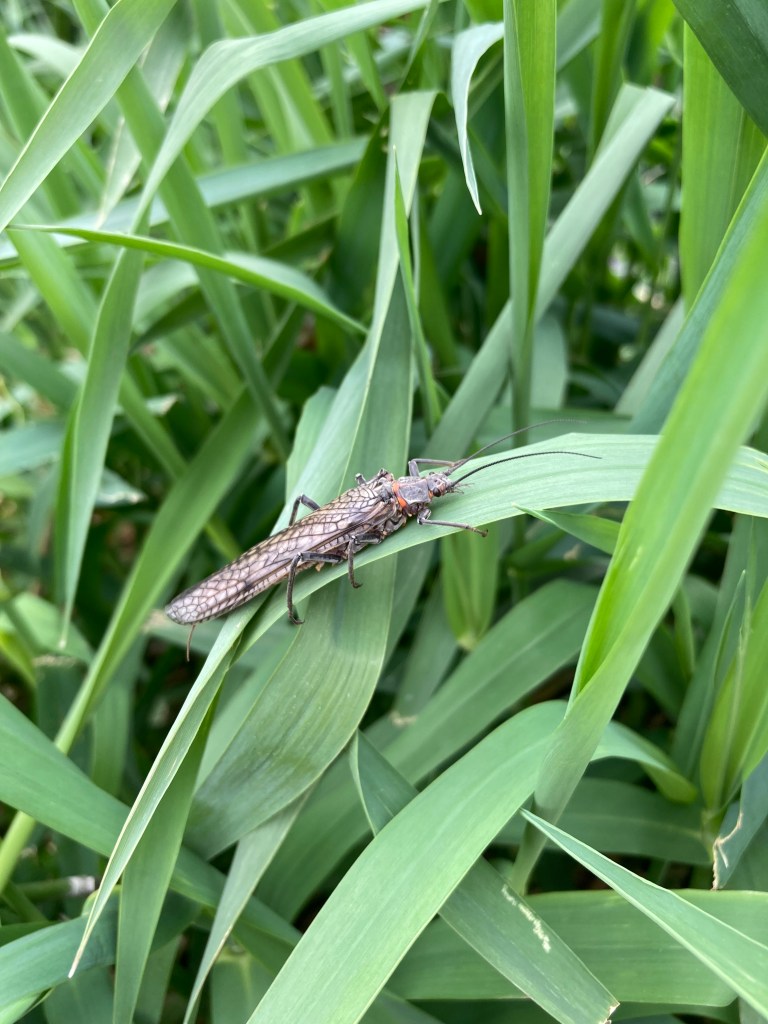
I know it’s time to fish the dry dropper when the dogwoods explode with foliage and the grasses awaken from their winter slumber to weep over the banks. With Memorial Day quickly approaching, the big bugs begin to emerge, sending out scouts in anticipation of the annual salmonfly hatch.
It’s probably my favorite way to fish a dry fly. It offers the consistency of nymphing, coupled with the excitement of explosive surface takes. The only catch? You need to commit to fishing one fly or the other with integrity. It’s very difficult to fish two different strike zones—running at differing current speeds—effectively.

When I fish dry droppers in fast water, I usually tie on something big, visible, and buoyant. Think Chubbies, hoppers, large Stimulators, and Clark Stones. For the dropper, I tie something dense that sinks quickly, such as a Perdigon or bead-head Pheasant Tail. It needs to be heavy enough to reach the strike zone—but not so heavy that it sinks your dry.
Certain species of bugs prefer fast water more than others—namely, stoneflies and caddisflies. For the dry, I like to match the hatch with Clark’s Stones and Chubbies. Clark Stones are my favorite: they’re easy to cast, more realistic than a Chubby, and less resistant in the wind than a big chunk of foam. On the dropper, I opt for something impressionistic that sinks quickly—think size 14–16 olive Perdigon or flashback bead-head Pheasant Tail. The dropper should tumble in the current and over boulders like a real nymph.
The length of your dropper depends on how deep the riffle is. Sorry—there’s no universal answer to “Is it long enough?” I’ve fished droppers as short as 18 inches and as long as 5 feet, and they’ve all caught fish. The trick is finding a length that gets into the strike zone while still allowing the dry to drift naturally. Too short, and you’re not getting down. Too long, and you’ll hang up constantly. But the occasional hang-up? That usually means your dropper is dialed in. Just beware that too much length introduces slack, which can cost you strikes.
There’s plenty of debate on how to attach the dropper to your dry. I’ve tied off the bend, the eye, the tag, and a tippet ring. They all catch fish, but tying off the bend is the easiest and most pleasant. If you keep the barb on your dry fly, you can tie on using a basic clinch knot in five seconds and start fishing. If you’re adamant about fishing barbless dries (I exclusively fish barbless nymphs), then tying off the tag end of a blood knot is my favorite. The right-angle coming off the blood knot lets your dry drift freely and helps prevent tangles better than an Orvis tippet knot or triple surgeon’s. Check out my post on different fishing knots to see what to use in each situation.
Don’t overcomplicate tippet choice. Use 3–4X to your dry fly and 4–5X to your dropper—this works well in fast western water. Fish aren’t as tippet-shy as you’d think, and fast currents put stress on your tippet even when you’re into half-pound fish. I fish a 7.5–9 ft tapered leader for dry dropper setups. With this technique, you’ll often need to cast under overhanging limbs, and a long leader won’t do you any favors—unless you’re fishing a spring creek with tons of microcurrents.
-T

Leave a comment