
I’m strictly a catch-and-release angler—well, maybe more like 95% of the time. Still, I believe catch and release is the most sporting way to fish for wild trout. We have a moral and ethical responsibility to advocate for our local rivers and preserve them for generations to come. After all, the fish will outlast us long after we keel over.
I’m here to talk about how to ethically handle wild trout for catch and release. I’ve seen too many fish go belly-up within 30 seconds of being “released,” usually because someone needed a crappy iPhone photo. We can—and should—do better.
Why Practice Catch and Release in the First Place?
For starters, in some places, it’s the law. Don’t be that guy who keeps fish in a stream that’s already on the decline. The game warden may not have seen you, but Jesus did. So did Santa Claus, and that’s why you got coal in your stocking instead of the $1,000 Sage your wife promised you.
The bigger reason—and why regulations exist—is because catch and release benefits the river. These fish already face enough stress: polluted tailwaters, pH imbalances, swinging temperatures, and declining insect hatches thanks to poor water management. Catch-and-release fishing reduces mortality, which gives anglers more opportunities to hook into fish. More fish in the river means more spawning, which (when done right) leads to greater abundance overall.
So how do we practice ethical catch and release? Let’s break it down.
Don’t Overplay Your Fish
That half-pound dink you caught on your 5-weight doesn’t need to be played out for five minutes. In fact, most steelhead don’t either—if you’re applying proper side pressure and playing fish strategically. Here’s what to do:
Set the hook with authority. Use the butt of your rod to apply side pressure. Play the fish in softer water rather than letting it wear you out in heavy current. And for the love of trout, fish barbless and use the right tippet size. (I’ve got an entire post on why barbless hooks are the way to go.)
Keep ‘Em Wet!
Always wet your hands before handling a fish. That slime coat protects them from infection, and your dry, chapped hands will rub it off—guaranteed. Also, use a rubberized landing net instead of those old-school nylon mesh ones that damage scales and fins.
Keep the fish’s head and gills in the water so it can recover. When releasing, point its nose into a gentle current and allow its gills to reoxygenate. Support the fish until it swims off on its own. Simple.
The Money Shot
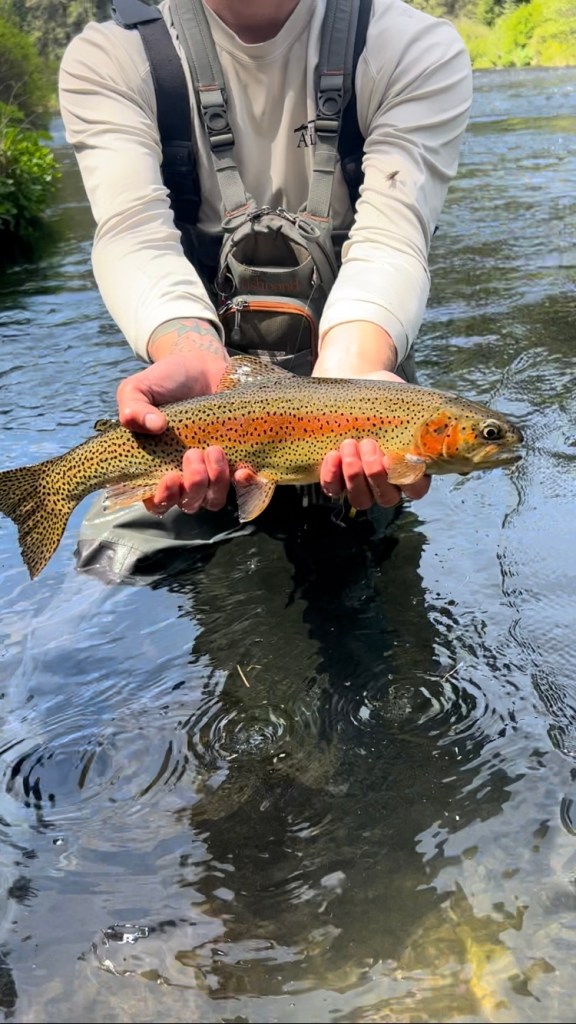
I don’t take many fish pics—because it’s not great for the fish. But when I do take a photo or video, I follow a few basic rules:
- Let the fish recover a little before handling.
- Support its body so you’re not stressing or compressing internal organs.
- Take a video instead of a photo—videos are quicker, and you can screenshot your favorite moment later.
To do it right: support the fish, gently lift it out of the water, pause in-frame for just a second, and then help it back in. Easy. I’ve seen way too many guys re-dunk and re-shoot their catch 15 times like some kind of botched baptism. Don’t be that guy.
Be Mindful of the Temperature
I’m talking both air and water temps.
Don’t shoot a dozen photos on a 90-degree summer day. That’s like holding your fish up to a heat lamp. But even more important is the water temperature. Trout and other salmonids are cold-water species. When water temps rise above 65°F, things start getting dicey. At 70°F, it’s downright dangerous.
Even if you do everything right, a fish released into warm water might still die from stress and lack of dissolved oxygen.
At the end of the day, it’s on us as individual anglers to act as conservationists and ambassadors for the sport. We owe it to future generations to preserve the rivers, fish, and wild beauty we’re lucky enough to enjoy.
Fish hard—but don’t be hard on the fish.
-T

Leave a comment