
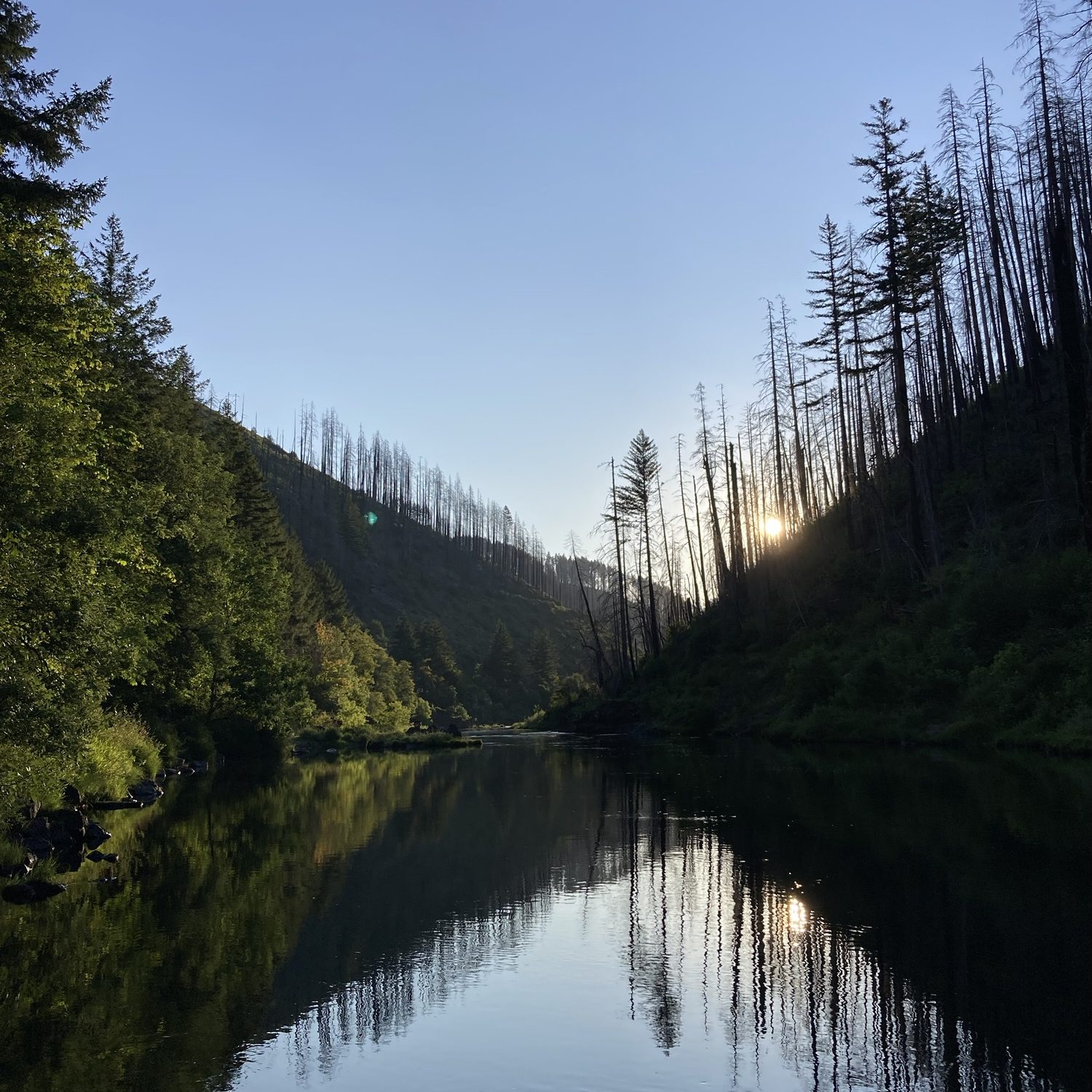
The North Umpqua River originates high in the Cascades—in the Mount Thielsen Wilderness, to be precise. It slides down the western slope into Toketee Lake, where we set up camp. The 33 miles of fly-only water below the lake are heavily regulated, wild, and beautiful. Like the Deschutes, the North Umpqua is home to Oregon’s wild native steelhead. The river is rich in history and is known as one of the most challenging and rewarding steelhead fisheries in North America.
Setting Up Camp
It takes me about two and a half hours to drive from the north end of Redmond, where I live, to Toketee Lake Campground. It’s a straight shot down Highway 97 before heading west on Highway 138, past Crater Lake, and into the Umpqua National Forest.
Toketee Lake Campground is one of my favorite places to stay for several reasons:
- The campsites are tucked along a thin stretch of the river.
- There’s plenty of room to spread out.
- It’s a central location for a variety of family activities while staying close to my favorite fishing holes.
Toketee Lake is big enough for paddleboarding, kayaking, or canoeing. It’s just a 4-mile drive to the Umpqua Hot Springs and a short walk from the Toketee Falls Trailhead. The campground sits at the inlet where the river flows into the lake—meaning the trout fishing is usually excellent.
There’s plenty of structure here to shelter both brown trout and rainbows. The dry fly action can be stellar. Just out from the inlet are thick weed beds. Paddle out and your fins will get wrapped—guaranteed. But if you’re bold enough to cast into the weeds, you just might connect with one of the bigger fish that cruise the lake.
The Fly Water
The North Umpqua might be my favorite river to fish, not only for its beauty but for the fly-fishing history etched into its pools and banks.
The water is cold—very cold. Both summer and winter runs of steelhead travel hundreds of miles from Reedsport to reach the Steamboat area. About two-thirds of the run head up Steamboat Creek, namesake of the Steamboat Inn, which has kept fly fishers warm and fed since the 1950s.
The regulations on the fly-only section are stringent:
- No fishing from floating devices
- No indicators or attached weights
- Single, barbless fly only
- Between July 1st and September 30th: fly must be unweighted
This level of restriction creates a competitive fishery that rewards traditional techniques and tests an angler’s skills. Success relies on:
- Using sink tips to achieve proper depth
- Reading water accurately
- Managing line in conflicting currents
And based on current fish returns, success tends to be rare.
The Magic of the Floating Line
The summer steelhead here are known for being surface-oriented. That means anglers get the privilege of swinging flies using one of the most enjoyable methods possible.
The setup is simple:
- Floating lines
- 15-foot tapered leaders
- Light flies like muddlers, bombers, and skaters
Fish these early in the morning before the sun and crowds hit the water. Choose a run with even current, make your cast, and let the fly wake slowly across the surface. After 10am, your best bet is a traditional hair wing fly paired with an intermediate polyleader. Check out my other posts on rigging for summer steelhead for a more in-depth setup breakdown.
My personal success came on the one morning I dedicated to swinging for steelhead during our long weekend. I left camp at 4:45am, careful not to wake my fiancée (she’s a light sleeper). Some of my favorite pullouts were already taken—word must’ve spread that the fish were showing up in the fly water.
Eventually, I settled a few miles below Steamboat Inn at a smooth, glassy run. The head of the pool was turbulent, but it soon transitioned into a slow, even flow—4 to 6 feet deep—before reaching the tailout where the current picked up again.
I started at the top of the pool, casting a size 5 black muddler tied in the style of a green butt skunk:
- UV chartreuse thread butt
- Slim black body
- Red cactus chenille bolster
- Black spun cow elk
- Lady Amherst tailing, replacing the usual white wing
The first half of the run offered nothing. Then, about 30 yards above the tailout, I heard a splash behind me and turned to see a chrome flash disappear into the current. That fish wasn’t interested in my muddler.
Still, I swung the fly through the tailout. The water split around a submerged volcanic spine just beneath the surface. At the top of that spine, I saw a swirl, then a nose breach the water and pull my muddler under. The line drew tight—two deep pulses—and then nothing. I tried again. Nothing. Swapped flies. Still nothing. Such is the North Umpqua.
The Rest of the Weekend
The rest of the weekend was filled with great food and even better company. My brother, his wife, a longtime friend, and my fiancée joined me fireside. We cooked steaks, paella in the Dutch oven, and even breakfast s’mores. I might do a separate post soon with some of my favorite Dutch oven recipes.
While the ladies hiked to the hot springs one morning, my brother and I explored the trout water above the Steamboat Creek confluence.
This stretch is more riffled, bouldery, and generally trouty. A 5wt rod is overkill for most of the fish you’ll catch here, but you might need a 6wt in case a steelhead shows up. The technical dry fly fishing was a blast, and the cold, clear water let us watch trout inspect our flies before softly sipping them and disappearing behind their chosen boulders.
Steelheading on the North
I absolutely love this river and the challenge it represents. Fishing here is almost spiritual. While I have yet to land a steelhead from the North Umpqua, that fact speaks to the difficulty of the fishery.
Hooking a fish here is the culmination of:
- Years of practice swinging flies
- Dozens (if not hundreds) of hours on this river
- A masochistic willingness to get skunked
We’re casting to fish that are already skeptical of flies, in what might be the most technically demanding fly water in North America.
But it’s that possibility—that the next swing could be the one—that keeps me coming back. That, and the memories.
– T

Leave a comment