
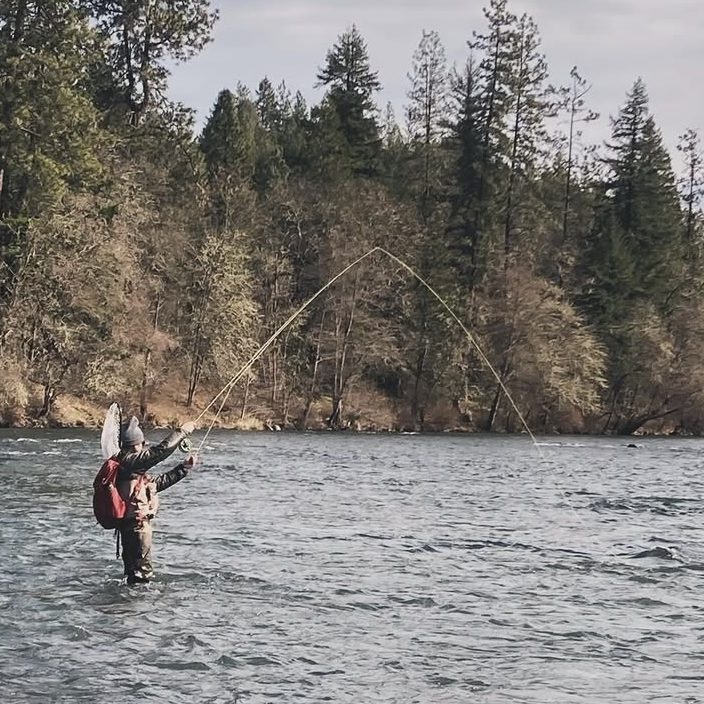
Winter fly fishing for steelhead is tough, to be honest. It’s cold, rainy, gray, and unforgiving. River levels are at the mercy of the weather and can turn unfishable in an instant. I spend my winters glued to the weather app—at least when I’m not glued to the fly-tying vise. I’ll be honest, most of my winters are spent fishing the Metolius and restocking my flies for next year, but sometimes the itch is just too much. Here is a rough guide on how to approach winter steelheading when the urge becomes too great.
Rivers We Fish in Oregon
In the winter, most steelheaders turn toward the coast. Everything east of the Cascades—including the Deschutes—is devoid of fresh steelhead since these rivers only get summer-run fish. We load up our trucks and head west toward the Umpqua, Alsea, Siuslaw, Siletz, and any of the north coast rivers near Tillamook Bay.
Personally, I end up at the North Umpqua since it has about 30 miles of protected water reserved for fly fishing only. Many of the coast rivers become crowded with gear anglers excited by the possibility of bleeding out a 15-pound chrome-bright fish. Can you blame them? I tend to get nervous about my swung flies being remotely effective when competing against the Blue Fox spinners, plugs, fluorescent beads, and egg sacks saturating the local waterways. Maybe fly anglers are just jealous, and that’s why we look down on the gear guys.
A goal of mine this year is to explore southwestern Oregon steelhead rivers a bit more seriously. My thought is that the distance from major population centers—especially Portland—will lend itself to more solitude, and hopefully more fish. I’m talking about rivers besides the legendary Rogue and Umpqua. Places like the Coos Basin, Coquille Basin, Smith River, and even as far south as the Chetco.
River Conditions Trump Fly Choice
Many will skim past this section to check out fly choices, but river conditions are paramount in winter steelheading. Fish get very lethargic once water temps hit the mid-40s and are unlikely to take your fly unless it’s put within a foot of their face. Literally. It’s times like these that steelhead slide into deeper, slower water that’s less conducive to swinging a fly. Combine that with an angler’s lack of control over a swinging fly (myself included) and your chances at glory are slim. Your best bet is to take advantage of brief spikes in water temperature that get the steelhead moving again.
Rains and snowmelt have a major effect on river conditions. DO NOT TAKE THIS LIGHTLY. A big rainfall in the mountains can trigger sudden spikes in water level that become straight-up hazardous. The same can be said for sudden winter “heat waves” that melt enough snow to cause a small flood. Be mindful of both of these weather events and track your river flows religiously.
Rain and snowmelt also affect water clarity, but I’m not so worried about that. Yes, arriving at the river to see muddy chocolate milk is unfishable, but a slight color-up is not the end of the world. Stained water just means you need to increase the size/profile of your fly and slow down your pace. Fish a bit deeper and take half-steps through the run to make sure any willing fish have a chance to see your fly. The “two big steps” rule of summer steelheading will do you no favors during the winter.
The Misconception About Sink Tips
Sink tips are indispensable during the winter, but you shouldn’t fish T-14 on every cast. Sink tip choice depends on water speed, water temperature, water visibility, and fly weight. It’s a lot to consider, but I’ll try to break it down.
Most of the fishing you’ll do in 4–6 feet of water can be done on a type 3 as long as the water speed is fairly slow. Combined with a moderately weighted fly, you will get into the strike zone just fine. Remember, you only need to get within a foot or two of fish faces.
T-8 is my go-to for most winter situations since I can adjust my depth easily using fly weight. T-8 gets me by at most water speeds and at most depths I enjoy fishing. Deeper holes warrant a slightly heavier bug, and shelves sloping up in a tailout sometimes call for an unweighted fly.
I usually reserve T-11 and up for deep buckets with fast current barreling over the top—think the head of a rapid with a steep drop-off holding fish over six feet down. The sink tip is mostly there to cut through that top layer of raging water and give your weighted fly a chance to hit the strike zone. With the exception of a couple buckets on the North Umpqua, I tend to avoid this type of water.

The 3 Best Flies for Winter Steelheading
Intruder — A classic winter producer. Tie it with as much variety as your imagination can come up with. I actually did an entire post dedicated to this swinging staple.
Graboid Leech — Its beauty lies in its simplicity: a bunny strip, some dubbing, a conehead, and a trailing hook. This fly has a pushy head and some serious profile. Tie it in various sizes and colors depending on water quality.
Hoh Boh Spey — The one I probably reach for the most. This fly does best in slightly slower runs with clearer water. Since it’s the smallest of the three, I don’t reach for it as much when steelhead only have a brief shot at seeing the fly (heads of rapids, quicker water, heavily stained water).
Bringing It All Together
Winter steelheading in Oregon is as challenging as it is rewarding. We have a variety of rivers to choose from, but some can be more crowded than others. Keep a close eye on the weather app and flow reports—if only for your safety—and match your fly to the conditions. Don’t let the cold weather keep you from fishing. But if it does, take advantage of the downtime to tie some flies with a glass of decent whisky to warm your soul.
Stay warm, my friends.
—T

Leave a comment