
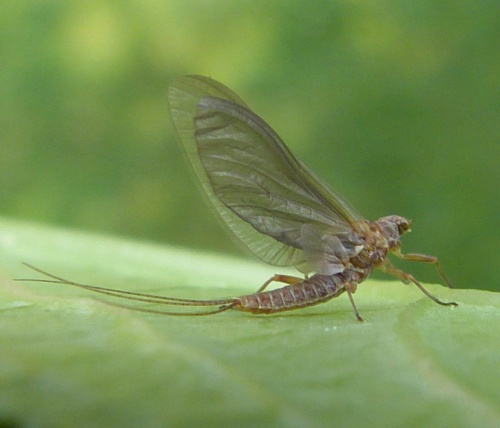
I’ve been doing some reading on more traditional flies, and I’m excited to fill my fly boxes with them this winter. When the weather keeps you off the water, there’s nothing quite like sitting at the vise with your favorite warm beverage in hand. This is a short list of classic mayfly patterns that act as solid general practitioners and cover most hatches you’ll encounter throughout the year.
Mayflies
Mayflies—Baetis included—are an incredibly diverse group of insects. I love mayflies because of this diversity and the fact that they’re present year-round in several different forms. From nymphs to dries, there’s no shortage of patterns you can dream up to imitate a mayfly on your local waters.
Mayflies are fairly easy to identify on the water. They’re the ones with three tails and stunning, sail-like upright wings. In flight, they tend to look like they’re dancing or gently fluttering, unlike the more chaotic flight of most caddis species. Don’t get too hung up on identifying mayflies as Cinygmula, Hexagenia, Callibaetis, etc. Instead, look in your box and pick the best color and size match. A good rule of thumb is to go one size smaller than you think you need.
Tying Up Some Bugs
For all intents and purposes, we can group mayflies into three major categories: small, medium, and large. Small mayflies include BWOs (blue-winged olives) in sizes 18–24. Medium mayflies include sulphurs and flavs, among others, in sizes 14–18. Large mayflies include drakes and hexes in size 12 and larger.
Most of the following patterns act as solid general practitioners for any of these categories—just adjust your sizing. I’m going to focus on dries and emergers specifically.
Olive Dun Quill
- Hook: Size 16 or smaller dry fly hook
- Thread: Light olive
- Tail: Small bunch of blue dun spade hackle fibers
- Body: Olive-dyed quills
- Wings: Divided pair of blue dun hen hackle tips
- Collar: Blue dun hackle

BWO Palm Emerger
- Hook: Size 16 or smaller curved dry fly/nymph hook
- Thread: Pale olive
- Tail: Small bunch of wood duck flank fibers
- Body: Olive-dyed goose or turkey biot
- Thorax: Pale olive rabbit fur dubbing
- Hackle: A couple turns of blue dun hen hackle
Royal Wulff
- Hook: Size 12 or smaller dry fly hook
- Thread: Black
- Tail: Small bunch of black moose body hair
- Body: Fine peacock herl with a red floss joint
- Wings: Divided; snowshoe hare foot, calf, or goat
- Collar: Dark brown or furnace hackle
Biot Drake Parachute
(Use brown or tan materials for Brown Drakes)
- Hook: Size 12
- Thread: Olive
- Tail: Bleached moose body hair or blonde elk
- Body: Olive turkey biot
- Wings: Webby hen neck, hen back, or blue grouse flank wrapped into a parachute post
- Thorax: Olive rabbit fur dubbing
- Hackle: Mixed olive-dyed grizzly and blue dun, tied parachute style

Red Quill Spinner
- Hook: Size 12 or smaller dry fly hook
- Thread: Brown or tan
- Tail: Split white or cream spade hackle fibers
- Body: Natural reddish-brown quills, or reddish-brown thread in smaller sizes
- Wings: White or cream hen hackle tips tied spent
- Thorax: Rusty brown rabbit fur dubbing
A Note on Spinners
Have you ever noticed that most spinner patterns in fly shops are tied beautifully, with wings perfectly perpendicular to the body? Me too—and I don’t like it.
I recently read a book that confirmed my suspicion that spinner dries are often tied too perfectly, and I plan to adjust my tying accordingly. Spinners should look like dead bugs. That means mangled, broken, and dragged through the current. It’s worth experimenting with spinners tied with a missing or broken wing, wings set at odd angles, or even flies tied on hooks with slightly bent shanks. Try it out and see how you like it.
Wrapping Up
There’s no way I could write a post covering every fly for every mayfly species you’ll encounter on your local water—especially once you factor in nymphs. What I do know is that trout are less picky than we think, and it pays to get good at tying a few core patterns in a range of sizes and colors.
Winter is the perfect time to practice tying mayflies, and it’s gratifying to know you can fish those patterns nearly year-round—at least when it comes to BWOs.
Signing off. See you in 2026!
—T

Leave a comment