Blog

  • 10 Great Gift Ideas for the Fly Fisher in Your Life (2025 Guide)

    If you’re like my fiancée, the holidays might feel a little intimidating. Well, it’s your lucky day! I’m breaking down some of my favorite pieces of gear at varying price points to help guide you in the right direction. Just make sure to buy from your local fly shop and support the folks who keep our communities running. From stocking stuffers to gifts that might make them cry tears of joy, here’s the list:


    This holiday season, fill their stocking with 30 cans of Rainier Beer.

    Stocking Stuffers (Under $20)

    Loon Classic Nippers – Fly fishermen are cursed with losing nippers, so it’s never worth buying expensive ones in my opinion. They also tend to wear out quickly. It’s always smart to have an extra pair on deck. While I’m on the subject: the most foolproof way to secure your nippers to your pack or lanyard is with 30 lb Maxima and a couple of solid knots.

    Loon Rogue Forceps – I love the clamping power and nonslip grip on these pliers. They attach securely to my pack and haven’t failed me yet.

    Fishpond Swiftcurrent Thermometer – Every angler—especially steelheaders—should have a thermometer within arm’s reach. Use it to make sure water temps are under 65 degrees when trout fishing, and as a guide to predict daily bug hatches.

    30 Rainier Beers – Yep, you can absolutely stuff their stocking with 30 Rainier beers, retailing for $20 at any participating Costco in the PNW. They will be consumed.


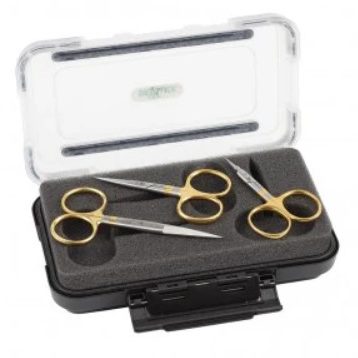
    These fly tying scissors are essential to my bench kit.

    Gifts Under $100

    Dr. Slick Prism Scissors Gift Set – My mom gifted me this one year and it’s been indispensable at my fly-tying desk. The set comes with three scissors in varying sizes plus a fly box that’s perfect for streamers or larger bugs. The scissors are sharp and they look rad.

    Fishpond Ripple Reel Case – Any serious fly fisher (including myself) has too many reels scattered everywhere. Even in their neoprene cases, they get buried and misplaced. My advice: get them a reel case that holds like six reels. Even if they don’t own six yet, they’ll fill it eventually. It also leaves room for extra spools, sink tips, leader packs—you name it.

    $100 Gift Card to the Local Fly Shop – If you’re still feeling intimidated, just get a gift card—maybe paired with a sweet hat repping the shop. It never fails, and serious anglers are constantly prowling the fly-tying section anyway. It might even help fund their next rod purchase.


    I love my Korkers Darkhorse wading boots. 10/10 would recommend.

    Baller Gifts

    Permission to Buy a Drift Boat (Priceless) – The gift that truly keeps on giving. Just give them the green light.

    Korkers Darkhorse Wading Boots ($230) – I’ve already written a full post praising these boots. I love the BOA system, the support, and the ability to swap soles in seconds. My fiancée gifted me a pair, and they were the wading boots I didn’t know I needed. I’m never going back to laces.

    A Guided Fishing Trip (Prices Vary) – Head to your local fly shop and grab a voucher for a guided trip on your home water. In Central Oregon, I highly recommend the crew at Fin & Fire in Redmond. The guys are cool, knowledgeable, and know the Deschutes better than their own kitchen cabinets. Most trips are priced for two anglers, so they can bring you or a buddy along.


    This Is By No Means an Exhaustive List

    Gifting for the fly fisher in your life doesn’t need to be stressful. There are a few key items—especially at lower price points—that will always be useful and appreciated. I’m actually planning a separate post just for gifts under $20 for the budget-conscious or anyone just looking for solid stocking stuffers. Whatever you get them, they’ll appreciate it.

    Happy Black Friday Weekend!
    – T

  • Steelhead Intruders 101: What They Are and How to Fish Them Effectively

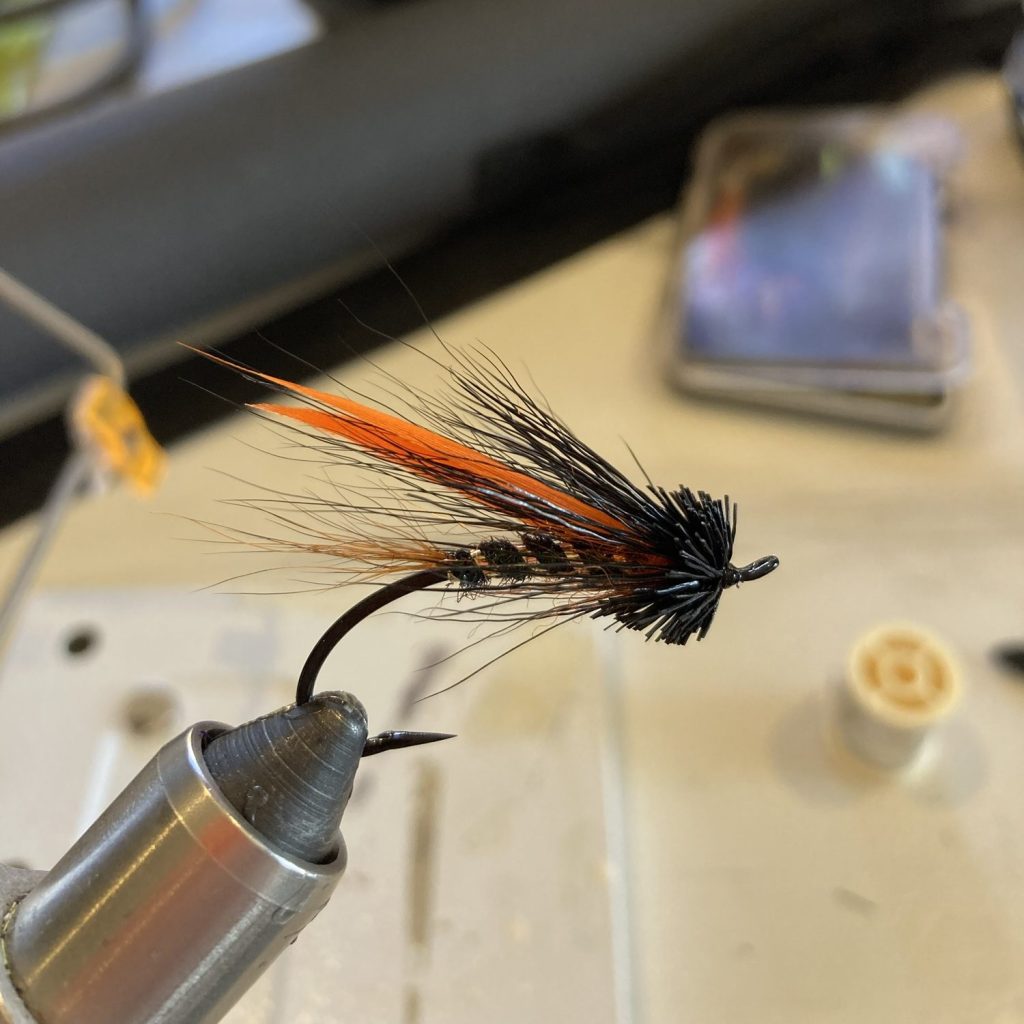
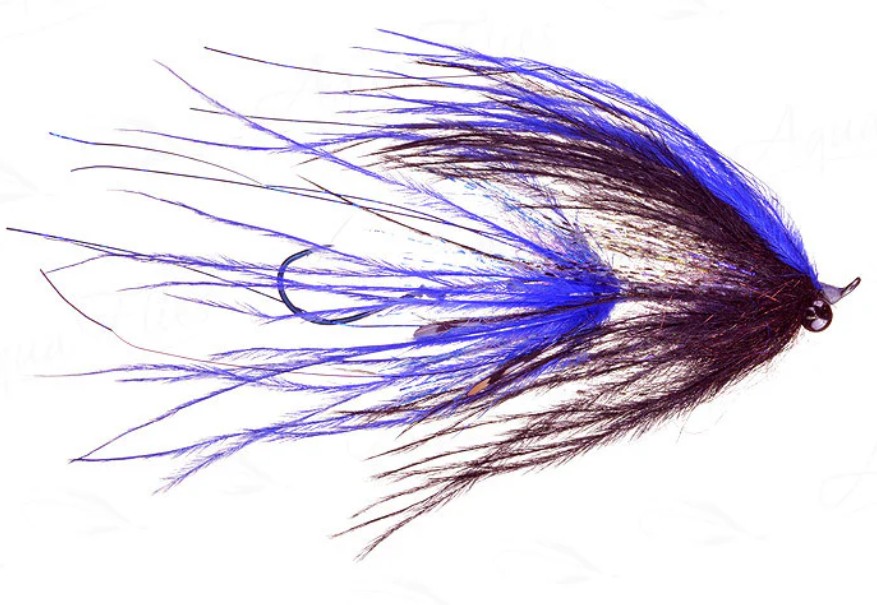
    Jerry French’s Intruder

    If you’ve fly fished for steelhead, you’re already familiar with the Intruder. But the Intruder is more than a fly-box staple—it’s an entire category of stinger-style flies tied on shanks, all sharing a big-profile, high-motion design. Here’s a breakdown of the modern Intruder and why not all versions are created equal.


    The Origins of the Intruder

    The Intruder is generally credited to Ed Ward and Jerry French in the early 1990s. The fly was big, buggy, leggy, and downright obnoxious—yet surprisingly unbulky. Materials with movement, like marabou and ostrich, created that signature flowing profile without adding much weight. The Intruder pioneers wanted something swimmy that wasn’t too difficult to cast.

    The original versions were tied on long streamer hooks, but modern Intruders have evolved. Today most are tied stinger-style on shanks, which allow for short-shank hooks that reduce damage to fish and limit the leverage fish have during the fight. More hookups, less harm.

    Some anglers tie Intruders on tubes instead: the leader runs through the tube and directly to the hook, with a short piece of flexible tubing keeping everything aligned.


    Basic Construction

    Intruders are tied in two sections on a shank or tube. Each section starts with a stiffer base material—like webby schlappen or bucktail—to support the longer, flowier fibers that give the fly life. Flowy fibers typically include marabou or ostrich. Some guys use rubberlegs or other synthetics.

    Between these stations sits the body, usually made of tinsel, chenille, or light dubbing. Ribbing and flash are common additions.

    Variations can include rubber legs, rabbit or squirrel strips, arctic fox, Amherst fibers, and more. There’s a ton of room for creativity.


    How to Make These Flies Effective

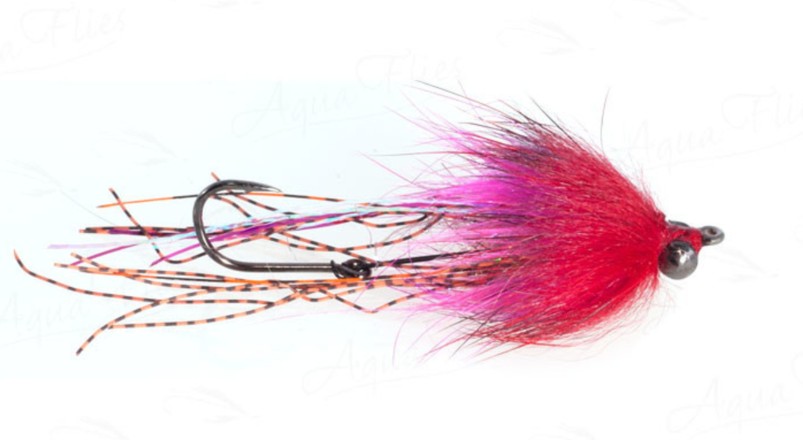
    Brett’s Klamath Intruder

    The Intruder is a blank canvas. Its effectiveness comes from the profile, and the ability to customize that profile to match your river conditions.

    My biggest piece of advice: tie these flies smaller than you think, at least for the Deschutes. Save the big dogs for stained water. My most productive Intruders are 3–4 inches long with a smaller rear section and a larger front section. This creates that layered effect and supports the longer front fibers.

    Just as importantly: use fewer materials than you think you need. Sparse is better. Too much marabou leads to bulky, hard-to-cast flies that trap air and ride too high—exactly what you don’t want in winter when every inch of depth matters.

    I like tying high-contrast color schemes, usually black paired with blue, purple, or hot pink. I bury my brights under black ostrich or marabou to tone down the intensity. This lets you easily adjust the black-to-color ratio for different water conditions:

    • Slow, clear water: shorter fly, heavier on the black
    • Stained or fast water: bump up the color
    • Very dirty water: black stays visible quite well, fish a big boi

    A little fluorescent hot spot doesn’t hurt either. I like chartreuse at the butt or a small orange hit near the eye for an egg-sucking leech look. But overly loud flies feel out of place on pressured rivers like the Deschutes and North Umpqua, so I keep it subtle. 


    Some of My Favorite Intruder-Style Flies

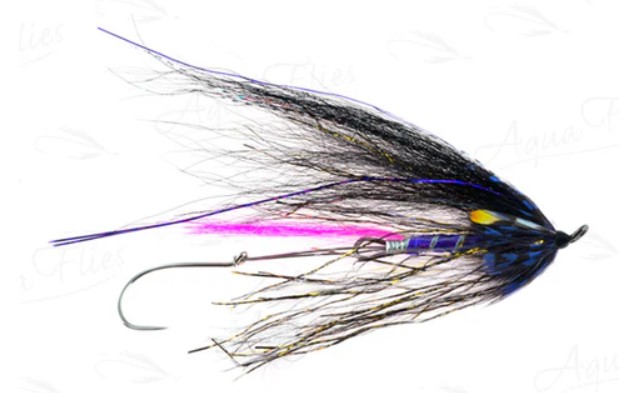
    Greg Senyo’s Predator Scandi

    Scandi Intruders – Light, wispy, and killer in gin clear or pressured water. The hairwing is the signature here. Elegant and deadly.

    Mini Intruders – My most-tied version. Perfect for pressured steelhead and excellent for trout spey. These flies teach you discipline—every wrap matters.

    Jerry’s Intruder – French’s original concept: sparse, contrasting, and flashy in the right places. A true classic.


    Wrapping it Up

    Intruders reward creativity, but they fish best when tied sparser than you expect. Visualize your final profile before laying down your first thread wrap. Jerry French’s Classic Intruder is still the gold standard for a reason and makes for a good reference when staying true to the original concept.

    They’re fun to tie, fun to fish, and just plain fun to look at. Hard to beat an Intruder—or any of its countless riffs.

    Fish ’em hard.

    –T

  • The Fly Fisher’s Gear Obsession: Why We Collect and How to Cope

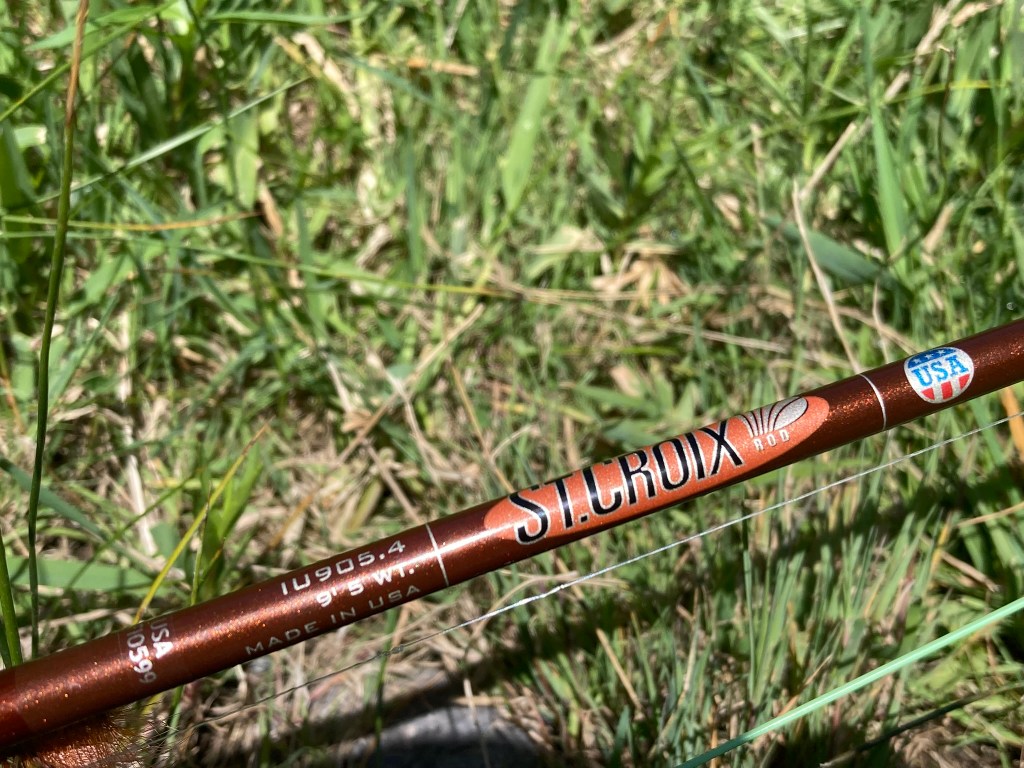
    My St. Croix Imperial is nothing to write home about, by it oozes pure value. Notice how, though it was once shiny, it is not anymore.

    I’m guilty of it myself. The collection of rods, reels, fly lines, and fly-tying materials keeps growing. At the pace I’m going (which is modest compared to others in my circle), I might need to start saving for a bigger house. Imagine it: a home filled with fishing gear—and a closet for my fiancée and me to sleep in. Hopefully, that closet is big enough for the dog, too.


    Why Anglers Collect Gear

    It’s both a practical and a philosophical question. I’ll start with the practical side since that’s the easier one.

    More gear means (hopefully) you’re ready at a moment’s notice for any fishing situation you might encounter. Did you start the day swinging for trout with a spey setup, but suddenly there’s a sweet Cinygmula hatch? You’ve got a dry-fly rig ready to rock. Skunked on the hatch and need a morale boost? Luckily, your trusty Euro rod is within arm’s reach. Having the right gear for any job feels comforting—especially knowing you’ve got the best possible tools for a specific angling task.

    The philosophical side is trickier. The first explanation for a garage overflowing with gear might be that the angler is compensating for a lack of skill—or at least a perceived lack of skill. Whatever the reason, that $1,000 rod could be compensating for something, especially when it’s paired with an overland-ready Tacoma TRD Pro. I just hope fly anglers aren’t getting too caught up comparing themselves to others, whether it’s about ability or gear envy.

    Fishing is deeply personal. We should do it for our own enrichment and enjoyment. Fuck what everyone else thinks—you should fish the way you want, without judgment. Yes, that includes you Euro-philes.

    Personally, I collect gear because it’s shiny—and my spirit animal might be a crow. I don’t know what it is about fly lines specifically that gets my juices flowing, because God knows my rod collection isn’t much to write home about. Almost all my rods were bought secondhand and have been loved to death. The big exception, of course, is my custom RB Meiser Highlander spey rod. That stick is my pride and joy.

    Rant aside, this might be the real reason anglers accumulate so much gear. The evidence is on the shelves of fly shops everywhere. Would Abel keep releasing limited-edition, overpriced reels if people weren’t buying them? And what about those nippers selling for a couple hundred bucks?


    The Cure to Your Gear Addiction

    Cut up your credit cards—or bring your wife to the fly shop. If you don’t have a significant other, find one who’s budget-conscious. It’s truly the only way to keep yourself from fishing your way toward bankruptcy.

    Beyond that, the solution is the same one I’ve been preaching on this blog since day one: buy solid gear at a fair price that offers great value in most fishing situations. You’ll never stop wanting new rods and reels, but buying quality gear that lasts will keep you from constantly chasing the next shiny thing.

    My 9’ 5wt St. Croix Imperial, for example, is a solid value rod that performs consistently well. At $60 off Facebook Marketplace, it’s hard to beat that kind of deal. Every time I look at new 5wt rods, I remind myself I can probably find one just as good for a better price in the classifieds.


    Anyhow, I’ll bring this ranty post to a close. At the end of the day, you’ll always want shiny new gear. Just practice self-control and remember that the fun of fishing lies in perfecting an art form that can never be perfected. Just like us, our angling is a constant work in progress. Expensive new shit might give you a brief dopamine boost, but the true pleasure of the sport is found on the water.

    Stay frugal, my friends.

    —T

  • The Nuke Egg: My Favorite Egg Pattern and How to Fish It Right

    A Quick Housekeeping Note: I’ve been posting consistently each Tuesday and Friday, but life has been getting pretty busy in my little household. I can’t keep up with writing high quality stuff twice weekly, and I’m definitely not willing to let quality slip. Moving forward you can expect the same juicy, mouthwatering content each Tuesday instead of the usual twice weekly. Thanks for being a good sport. Now back to the good stuff…

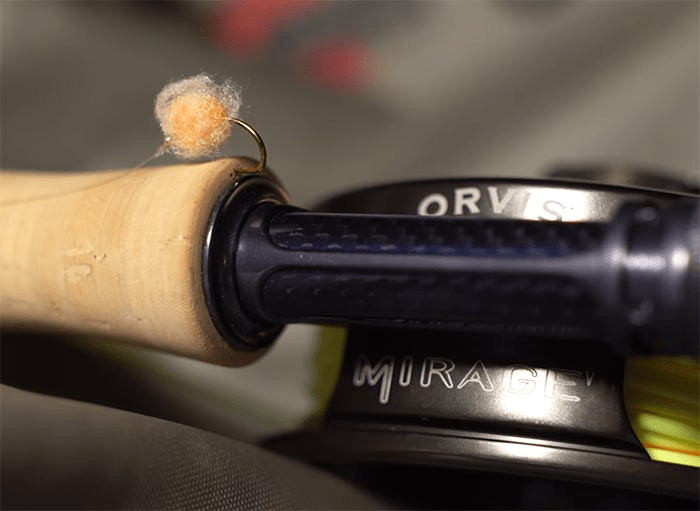
    The nuke egg as shown in an Orvis News article. My nuke eggs all look like crap from being fished.

    You know the situation is dire when the eggs come out. A lot of fly fishers shy away from eggs and other “junk flies” — and I get it. Eggs seem like cheating because they’re so damn effective. Still, I always have a selection in my box once winter hits. Usually, they make their appearance after I’ve been swinging for steelhead and need a little ego boost. Here’s a primer on my favorite egg fly and why it deserves a place in your winter fly box.


    What the Hell Is a Nuke Egg?

    The Nuke Egg is, at its core, a few turns of egg yarn with a milky veil surrounding it. It’s a lethal pattern because it gives your typical egg fly a more translucent, less aggressive look. It shines by imitating an egg that’s been drifting in the current for a while — maybe one that’s been recently fertilized, or still coated in the goo that binds a clutch of eggs together.

    Whatever the case, it just works. Every time.


    A Note on Ethics

    Egg flies sometimes get a bad rap because some folks fish them over active redds. No bueno. It’s seriously uncool to catch fish that are in the middle of creating future generations. Imagine if someone hooked you in the face while you were in the middle of doing the deed. Yeah — that’s what I thought.

    The truth is, egg flies excel when there are fish spawning in the system. The right way to fish them is well below the redds. Not the next hole down, not a couple hundred yards downstream — way down. Trust me, the fish will still be enticed by that protein-packed snack drifting tantalizingly in the current.


    How Do I Fish It?

    Egg flies, in my opinion, should bounce around almost weightlessly in the current. I like mine to have neutral buoyancy — meaning the fly neither sinks nor floats when placed in water. That makes all the difference, since real fish eggs have a slight weightedness to them but don’t plummet to the bottom.

    To get the flies down, I pair them with something heavy — usually a 4.6mm tungsten-beaded nymph. The heavy bead helps compensate for the pushy currents on the Deschutes and counteracts the egg fly’s lightness. Whatever anchor nymph you use, make sure it can drag your egg down with it.

    I tie the heavy fly to the tag end of my nymph rig and put the egg at the point. I like to give the Nuke Egg about 16–20 inches of line coming off the knot or swivel so it can dance naturally in the current.

    You can fish this fly almost anywhere — fast riffles, slow runs, or deep pools. Just adjust the weight of your rig accordingly. The egg performs well in fast water thanks to its fluorescent color and larger profile. It’s equally effective in stained water for the same reason, and it excels in slow, deep pools because of its natural profile.


    How Do I Tie It?

    This is an easy tie that’ll fill a fly box fast. I only use Semperfli EggStatic chenille because of its fluorescence and tiny flecks of flash that give the fly that “slushy” appearance. Experiment with colors to find your favorites — mine are Steelhead Orange and Atomic Yellow. I’d bet the Orange Tobiko variation would work great, but I haven’t tried it yet.

    I tie the fly on a curved 2X-heavy nymph hook with a wide gape, usually sizes 8 through 14, depending on what’s drifting in the system. The key is to add a few wraps of wire to the hook shank. The chenille and veil trap small air bubbles that can keep the fly from sinking. Without those wraps, your egg won’t bounce or “dance” properly in the current.

    The only tricky part is the veil. Pinch off a small clump of egg veil and align the fibers carefully — don’t cut them off the yarn bundle, since you want those wispy, uneven ends. Lay the fibers sparsely around the hook so they surround the egg, with about a third extending past the hook eye. After a few pinch wraps to secure, preen the forward fibers back and build a small thread dam to keep them angled rearward. Whip finish, add a touch of head cement, and you’re done.

    Recipe:

    • Hook: Size 8–14 curved nymph hook (Tiemco TMC 2488H or Ahrex FW540/541)
    • Thread: White, orange, pink, or red – your favorite kind
    • Underbody: Lead or lead-free wire
    • Body: Semperfli EggStatic 8mm chenille
    • Veil: Hareline Egg Veil

    Final Thoughts

    This fly quickly replaced the classic slush egg and is now the only egg pattern I carry. I love the way it looks when wet and how it moves in the current when tied correctly. I can’t keep fish off this thing, and it’s my go-to confidence pattern when steelhead season starts to wear me down.

    Give this fly a tie — I promise you’ll be impressed.

    —T

  • Why the 9’ 5-Weight Fly Rod Isn’t Always the Best Choice

    My first brand new rod was an Echo Carbon XL 9′ 5wt. A great starter rod.

    Ask most fly shops or bloggers what your first fly rod should be and you’ll almost always get the same answer: the ubiquitous 9’ 5-weight. It’s a solid choice on paper. The 5-weight handles most trout and small bass, and has enough power to deliver a variety of flies to their targets. The 9-foot length seems ideal — not too long, not too short. Enough backbone to get the job done without sacrificing too much accuracy.

    However, I don’t believe the 9’ 5-weight is the answer to every fly fishing situation — or even most. Far from it. Anyone who recommends a rod without asking a few key questions is doing you a massive disservice.


    1. What Species Are You Targeting?

    The perfect bass rod isn’t the perfect trout rod, and it definitely isn’t the perfect steelhead rod. Different rods are built for different species — but not for the reasons you might expect.

    Most freshwater fly rods can fight anything from small trout to big bass. I’ll leave saltwater out of this since a bonefish rod has no business tangling with a 100-pound tarpon.

    Your fly rod is a tool to get the fly to the fish. While a 5-weight can cast most flies, it struggles to handle the line and power needed to throw bass poppers or large streamers. A 5-weight will fight the fish just fine, but you need the backbone of a 6–8 weight to cast heavy, wind-resistant patterns effectively.

    Take musky flies, for example. Some anglers use a 9-weight because they need to throw what’s essentially a 10-inch tube sock lashed to a fly line. It’s not about fighting the fish — it’s about turning over that giant fly.


    2. What Style of Fishing Do You Like?

    Euro nymphing versus dry-fly purism. Stripping streamers versus swinging flies. Each discipline requires a specialized tool to do it well. The 9’ 5-weight can handle all of them, but it doesn’t excel at any of them.

    For example, fishing dries or indicator nymphing with a 9’ 5-weight is fine. Other rods might perform those tasks better, but the standard setup will put fish in the net.

    For euro nymphing, though, I want a long rod with a sensitive tip and powerful butt section. Purpose-built euro rods protect tippet better and fight fish above their weight class. The longer reach also helps you hit seams that are tough to access with just nine feet of rod.

    For streamer fishing, I prefer a fast-action 6–8 weight depending on fly size. A 5-weight can throw small streamers like Woolly Buggers, but anything bigger collapses the cast instantly. If you’ve ever tried casting a lead-eyed Sex Dungeon on a 5-weight, you know that fly isn’t going far. The heavy lines needed for big flies will overload a standard 5-weight to its breaking point.

    Swinging flies can be fun on a 9’ 5-weight — especially with a single-hand spey-friendly line like those from OPST. Smaller soft hackles swing beautifully on smaller water. But for longer casts or heavier flies, you’ll quickly crave something longer that stores more power through a deeper casting stroke.


    3. Where Are You Fishing?

    The rod I bring to the Crooked River isn’t the same as what I bring to the Deschutes or the Metolius.

    On the Crooked, I’m usually casting small dries or dry-droppers for smaller trout. On the Deschutes, I’m fishing big water with heavy flies — and the afternoon wind will test my patience. A heavier rod with a heavier line makes all the difference.

    If steelhead are in the system, I never nymph with my 5-weight. There’s always a chance of hooking one of these special fish, and I want to land it quickly without exhaustion. I’ll use my 7-weight switch rod or an 8-weight single-hand setup if I’m nymphing — though I’m usually swinging a spey rod when steelhead are running.

    Be realistic about where you fish and what you’re casting. Your rod should match the water, the flies, and the fish you’re after. Once you start thinking that way, the 9’ 5-weight doesn’t seem so “universal” anymore.


    I used my 9′ 5wt to slow-strip damselfly nymphs for brook trout on one of the local high lakes.

    So, What Should You Buy Instead?

    Before picking up another “do-it-all” rod, think about your local waters and the types of fishing you enjoy most. Here are a few alternatives that might surprise you:

    • 9’6” or 10’ 4-weight: A fantastic all-around rod. The lighter weight is perfect for smaller rivers, and the extra length adds versatility. It’s long enough for mending indicator drifts, but short enough for accurate dry-fly work. The extra length also makes it a great choice for trying your hand at Euro-nymphing or singlehand spey.
    • 9’ 6-weight: Honestly, I wish I’d bought one instead of my 5-weight. The 6-weight shines when wind picks up or when you’re throwing heavy rigs and streamers on big western rivers. It’s a much better match for the Deschutes or similar big water.
    • 8’6” 3-weight: A wildcard pick — but if you hike into small creeks or fish mostly dries for small trout, this rod is pure joy. It loads easily and makes modest fish feel like giants.

    Wrapping It Up

    Your “go-to” rod might not be what you expect. Don’t take a shop’s word for it — or a random blogger’s. Ask yourself the right questions so your choice has purpose.

    The rod you always reach for should do exactly what you ask of it, every single cast. If you only own one rod, make that choice count. Go deeper than the 9’ 5-weight — and you might just find the missing link in your fly fishing evolution.— T

  • Are Switch Rods Worth It? Pros, Cons, and My Honest Review

    I bought my switch rod because I thought it was the solution for my desire to learn anchor-point spey casting. I couldn’t afford a proper spey rod at the time—or so I thought—so I purchased a used Fenwick Aetos 6/7-weight switch rod. It’s a four-piece rod measuring 11’1” that I paid $135 bucks for on Facebook Marketplace. The rod was fun to cast, had a quick stroke, and could huck a Scandi line without much effort. However, it wasn’t until I earned my first full spey rod that I realized the faults in my fun little switch rod.

    For one, it was awkward to cast overhead. Single-handed? Forget about it. The full spey rod was also much more effective at covering water than the switch rod. Still, I eventually discovered that the switch rod has distinct benefits that make it a useful tool on the water.


    The Benefits of Two-Handed Casting

    A quick note on the benefits of casting with a two-handed rod:

    Number one, it’s just plain fun. I love the cadence of the cast and the dance the rod makes throughout the stroke. It’s what keeps me smiling even when I haven’t shaken hands with a steelhead in my past ten fishing days.

    Second, two-handed casting is efficient. Two-handed casts send the fly farther, allowing you to cover more water per cast. They also keep you fishing effectively in places where there’s no room for a back cast. Keeping your D-loop in front of you when setting an anchor prevents your line from hanging up in the bushes behind you.

    Lastly, two-handed casting is less fatiguing. It lets you stay fresh throughout a long day on the river.


    What the Hell Is a Switch Rod?

    The idea that a two-handed rod could be cast overhead is a relatively recent development in fly fishing. The switch rod was born in the 1970s as the brainchild of master rod maker Bob Meiser, and later became available for purchase in the 1980s.

    It’s also worth noting that when describing the history of the switch rod, Bob himself tends to call them “short two-handed rods.” Meiser came up with the concept as a solution for anglers who were used to casting heavy sink tips for steelhead on single-handed rods. As any serious caster knows, overhead casting heavy sinking lines all day can destroy your rotator cuffs.

    The solution? A rod that could be cast overhead using two hands. That’s right—a short two-handed rod designed for overhead casting, not anchor-point casting. This is why Bob didn’t call his development a compact, or short, spey rod.


    How Are They Different from Spey Rods?

    Full spey rods tend to be 12’6” and longer, though anything under 13’ is often referred to as a compact spey rod. Full spey rods are specifically designed for anchor-point casting using a two-handed stroke. Anyone who’s tried overhead casting a spey rod knows it’s not a pleasant experience.

    The switch rod, on the other hand, can be overhead cast. Its shorter length means less swing weight, which transfers the feel of the cast closer to your hands. Two-handed overhead casts are more powerful and simultaneously less fatiguing than their single-hand counterparts.

    That shorter length also makes switch rods easier to use in tight quarters. There are runs on the Deschutes, for example, where I have to crawl under trees on my hands and knees to reach my favorite starting point. A longer spey rod is far more cumbersome to maneuver than a switch rod—and once I’m in position, it’s easier to keep the shorter rod out of the branches overhead.

    That said, efficiency is where the spey rod beats the switch rod. My spey rod casts farther with less effort and covers more water. It also handles a greater variety of flies throughout the day, keeping me adaptable as conditions change.


    The Switch Rod Is Very Misunderstood

    It’s the opposite of what most people think. The switch rod is harder to cast than a full spey rod—at least when it comes to anchor-point casting. The casting stroke for a switch rod is quick and precise. Slow casting strokes, common among beginners learning spey techniques, tend to improperly load the rod and cause the caster to push through the stroke, overpowering it.

    In contrast, the longer spey rod actually rewards a slower, smoother casting stroke, making it easier for beginners to learn.

    Many anglers buy a switch rod thinking they’re getting versatility—but I think that’s more of a marketing ploy than reality. Switch rods are, frankly, pretty bad at being do-it-all fly rods.

    If you’re considering one, be honest about what you need.

    • If you want a compact spey rod for setting spey anchors under low-hanging trees, buy a switch rod designed for anchor-point casting.
    • If you’re fishing big flies for predatory species like musky, look for a switch rod that excels at two-handed overhead casting.
    • If you’re targeting windy lakes or ocean jetties, again, choose one designed for overhead work. Same goes for big indicator setups, though you might tangle up a lot your first few outings.

    How I Feel About My Own Switch Rod

    My Fenwick is set up for spey-style casting—but it honestly isn’t very good at it. The Rio Scandi Body line, with its 23-foot head and 400-grain weight, is the best match I’ve found for quick, compact spey casts on this rod. Despite that, the spey performance still feels lacking at times.

    The Fenwick Aetos lineup includes single-handed rods, and it feels like they simply made one longer to create their switch model. I’m not saying it’s a bad rod—far from it—but it clearly begs to be cast overhead with a line closer to 350 grains.

    My plan is to purchase a slightly longer switch rod—closer to 12 feet—to serve as my compact spey setup. The Aetos will then become my go-to rod for larger indicator rigs and big streamers for predatory fish.


    Making a Long Story Short

    Switch rods should really be referred to as short two-handed rods, and they definitely have their place on the river. However, you might be misguided if you’re buying one under the promise of flexibility.

    My advice: be clear about your needs and buy accordingly.
    If you plan to cast spey-style most of the time, choose a rod marketed as a compact spey or designed by a reputable spey-rod maker.

    And for beginners—don’t buy a switch rod thinking its shorter length makes it easier to cast. That’s an outright lie. It will only make your two-handed journey more difficult.

    Whatever you do, don’t discount the value of these rods. They occupy a specialized, important niche in your quiver.

    -T

  • Korkers Darkhorse Wading Boots Review: Durability, Comfort & Interchangeable Soles

    The Korkers Darkhorse wading boot.

    A good set of wading boots is your first line of defense on the water. When it comes to safety, boots are the most important piece of gear besides your wading belt—they’re what anchors you to the slippery river bottom. Slick rocks, smooth gravel, and large boulders can all threaten to send you swimming—unless you’ve got the right tool for the job.


    An Overview

    I’ve been rocking the Korkers Darkhorse boots for several years now. I’d had my eyes on them for a while after fishing the same felt-soled Simms Tributary boots for about two years. Eventually, I realized I needed higher performance and a few key features:

    • Ankle support – I wade in swift, rocky water where strong support helps prevent twisted or broken ankles.
    • Interchangeable soles – As an all-season angler, I don’t want to wear felt in the snow. Studded felt soles shine on my home waters, but they ice up in winter.
    • BOA system – Laces are fine, but not my favorite. The BOA resists freezing, allows micro-adjustments, and is easy to retighten as boots loosen throughout the day.
    • Solid drainage – Wet boots are heavy, and quick drainage keeps me moving from spot to spot.

    Korkers Darkhorse Field Review

    The Darkhorse checks all of my boxes. They’re durable, supportive, and quick-draining. I can swap soles streamside or as seasons change. They aren’t absurdly heavy, and the BOA system is my favorite feature—a premium I’m happy to pay.

    I’ve fished winters with traditional laces that froze solid, making it a pain to tighten boots once wet. The BOA solves that. It’s fast, easy, and adjustable on the fly. Getting in and out of the boots is quick, which is a blessing after a long day on the water.

    After several years of use, I can confidently say these boots hold up under tough conditions. Sure, the rubber can eventually split at the toe—but that happens with any wading boot. Even then, my toes are still protected. The replaceable soles are another huge plus: rather than buying a new pair of boots, I can refresh the grip for a third of the price.

    Fit-wise, they’re true to size. I wear a 10, and the BOA cinches evenly across my foot without pinch points. The boots were comfortable right out of the box—not overly stiff despite their robust ankle support. I’ve hiked plenty of miles in them, and they still feel great.

    My biggest complaint is the D-ring for gravel guards, which ripped out in a couple of months of heavy use. It almost seems like the D-ring was an afterthought when the boots were designed, and I would’ve expected them to be reinforced, especially since the boots are marketed for durability. Thankfully, my Grundéns Vector waders use elastic guards instead of hooks, so it’s not a dealbreaker. My only other nitpick is the tall toe box, which feels clunky at times—though it disappears when I’m in thick socks during winter.


    How They Compare to the Rest of the Korkers Lineup

    The Darkhorse is positioned as Korkers’ “do-it-all” boot—durable without sacrificing comfort or weight. At $230 (as of this writing), I think they’re a great midrange value, especially compared to premium boots like the Simms G4 ($500). That said, here’s where they stand against Korkers’ other options:

    • Greenback ($130) – Solid entry-level boot with interchangeable soles. Great for budget-minded anglers.
    • Chrome Lite ($200) – When you’re the fashion conscious angler and still want a BOA. Maybe you want to impress other dudes at the local watering hole. Reserved for anglers who can’t stop talking about their Orvis Helios 4.
    • Devil’s Canyon ($230) – Designed for anglers who hike a lot but don’t need max durability. Only 2 oz lighter than the Darkhorse.
    • River Ops ($300) – Built for heavy abuse and long days on the water. A guide’s boot. Supreme durability with comfort.

    A Quick Word on Soles

    Korkers’ interchangeable soles are their biggest advantage—it’s why I bought mine. Some anglers report losing soles in mud, but I’ve never had that issue. They’ve stayed locked in through gnarly rock gardens and knee-deep muck.

    Options range from felt, rubber, and Vibram to studded versions of each. Korkers also offers aluminum bars and hex disc soles. I haven’t tried the aluminum versions myself, but other anglers swear by the hex discs specifically for multidirectional grip since the soft metal actually bites into rock surfaces. If you’ve used them, I’d love to hear your take.


    Final Thoughts

    I love the Darkhorse boots for the balance of durability, comfort, and versatility they provide. The replaceable soles extend their life and adapt them to different conditions. At their price point, they punch well above their weight.

    At the end of the day, it’s worth making a list of the features you truly need for your home waters. Wading boots are the one thing keeping you upright and safe—so don’t be a cheap bastard.

    –T

  • Fly Fishing Strategy: Why Covering Water Increases Your Success

    Spey rods are the ultimate tool for covering water.

    I’ve been guilty of it myself. You pull up to a juicy run that’s usually elbow-to-elbow, but this time you have it all to yourself. You rig up, run down the trail, run back up because you forgot to lock your truck, run down the trail again—and then cast to the same two fish for the next couple of hours. This spot is always taken, so of course you want to get the most out of it. The fish will turn on; you just need to give them time. Or do you?


    The Problem With Staying Still

    Fish are constantly moving targets. Trout are always roaming the river in search of food, protection, and oxygen-rich water. Sometimes they get pushed out by larger fish, or maybe the current shifts and they tuck behind a rock for softer flow. They might move off a shelf and toward the bank in search of a clumsy evening mouse. They’ll also slide out or go down when spooked by a splashing angler.

    The point is simple: trout are living, breathing creatures in constant motion because their environment is always changing. Think about it this way—do you stay in one spot all day? I personally don’t eat, use the bathroom, drop off the mail, and walk the dog all from my couch.

    Steelhead take this concept to the next level. These migratory fish may hold in the same pool all day—or they might cover three full river miles daily during their upstream push to spawning grounds. A steelhead angler who camps on the same run (which may only hold a single fish at any given time) is setting himself up for disappointment. Not all steelhead are willing to take a fly, so it only makes sense to put one in front of as many fish as possible until you find that aggressive grab.


    The Efficient Angler

    Staying mobile is the single best way to put more fish on the reel—trout and steelhead alike. My number-one rule is to cover as much water as possible. If a trout doesn’t eat your fly within a couple of casts, it doesn’t want it. Move on. Fish that rock honestly, but don’t linger if the fish isn’t a player. It pays to seek out the ones that are willing.

    The efficient angler adapts to changing conditions and becomes wiser by fishing more water. Steelheading on the Deschutes is a great example. In the morning, skinny tailouts are prime for a skated or dry fly—no better time to find a steelhead willing to rise. I cover this water quickly since a player will usually reveal itself right away. If a fish rises but doesn’t commit to the dry, I’ll quickly swap to a wet fly and make the same cast. As the sun creeps over the canyon walls, steelhead become wary in the glare. Before it gets too hot, I’ll fish a sink-tip through the deeper slots where they’re less light-shy. And when the canyon bakes in the afternoon? That’s nap time.

    Efficiency also means pacing yourself correctly. Take the Boat Pool on the North Umpqua River—one of the finest steelhead runs you’ll ever fish. The Boat always holds fish. Summer steelhead will rise to a dry and move several feet from their lie to eat. That means I can cover ground fast: cast, swing, take two generous steps, and repeat. Winter fish are a different story. In turbid water, they’ll only eat when the fly swings within a foot or so of their face. That demands sink tips and smaller steps—sometimes just one per cast. Their behavior dictates the pace.


    When It Makes Sense to Stay Put

    There are times when it’s smart to work a spot hard. If trout are actively rising to a thick hatch, cast until your arm is sore. The fish aren’t shy, the bugs are abundant, and you’ve got plenty of targets.

    It also makes sense to slow down when a run has a lot of structure, as long as you can fish it effectively. Staying put doesn’t mean standing still—change your angles, wade to new positions, fish the opposite bank, and cover every side of that midstream boulder.

    Even when you linger, vary your tactics. Start with dries, then switch to emergers or nymphs. After nymphing, try a streamer to tempt an aggressive eater. Staying put shouldn’t mean staying stagnant.

    And in winter, patience really does pay. Cold water makes trout conserve energy, feeding lazily in troughs, slots, and ledges. Slow down, make efficient casts, and move on only after you’ve fished the water thoroughly and honestly.


    The Bottom Line

    The angler who keeps moving is the angler who fishes efficiently. Casting again and again to the same disinterested or spooked fish is wasted effort. Covering water increases your odds of finding players—fish that are actually willing to eat. Not every piece of water will produce every day. Conditions change. Fish move. It’s our job to adapt and keep searching.

    And if you don’t find players? Well, a day on the river is still good for the soul.

    -T

  • 4 Fly Fishing Leader Formulas Every Angler Should Know

    Ask 10 different anglers for their leader formulas and you’ll get 50 different answers. That’s because not only does each angler have their own proprietary setups, but different scenarios on the water call for different formulas. Below, I’ll break down four leader formulas that I’ve tested and found useful in various situations.

    I won’t dive into the specifics of my Euro nymphing rig here. If you’re curious about tying a simple mono-rig for Euro nymphing, [click here].


    Why Not Just Buy Tapered Leaders?

    Tapered leaders are great and certainly have their place. In fact, one of the easiest things to do when adapting a leader for a specific situation is to cut back a store-bought leader, add a tippet ring, and then reuse that leader as a butt section for the rest of the season. The customization comes from deciding which tippet diameter to add.

    The case for making your own leaders comes down to the philosophy of angler mastery. That means having the knowledge and skills to adapt your techniques to the unique conditions you’ll face on any given day. It’s the same reason many anglers (myself included) tie their own flies—more control and more opportunity to tailor your gear to your home waters. Building your own leaders gives you that same control, along with the satisfaction of becoming a more versatile angler.


    The Knots

    I’ve already written an entire post on various knots and when to use them—[link here]. For leader building, you only need three basics: the perfection loop, the blood knot, and the surgeon’s knot.

    • Perfection loop – for attaching leaders to fly lines, or for connecting butt sections to tippet sections when you don’t use a tippet ring, swivel, or blood knot.
    • Blood knot – for joining materials of similar diameter into a seamless, strong connection that passes easily through rod guides.
    • Surgeon’s knot – for joining lines of unequal diameter. This knot is bulkier, though, and can catch on rocks or rod guides.

    If you want to build your own leaders, you’ll need to be proficient with these knots. Tying your own leaders will help you tie better knots in the long run.


    The Materials

    I primarily use Maxima products for leader building.

    • Maxima Chameleon – stiff, low-memory material that makes an excellent butt section.
    • Maxima Ultragreen – more supple, better suited for the business end of the leader where stealth matters most. If I could only pick one, Ultragreen would be my choice for its versatility.

    For tippet:

    • Streamers – stick with Maxima Ultragreen for strength.
    • Dry flies/general use – cheap nylon tippet is fine.
    • Nymphing – fluorocarbon is worth it for stealth and abrasion resistance. Tip: buy fluoro in bulk from the conventional tackle section of your local sporting goods store (brands like P-Line or Seaguar). Fly shop fluoro is often the same stuff at a much higher price.

    The All-Purpose Leader

    This is your default “jack of all trades, master of none” leader. It’s designed for versatility, and most of that adaptability comes from the tippet section.

    You can taper the tippet section gradually or keep it simple with 30 inches of heavier tippet followed by 20 inches of your final diameter—just avoid large jumps in diameter. A max difference of .003-.005” is a good rule of thumb. Here a breakdown of the different tippet configurations:

    • Dry-dropper rigs – taper to 3X or 4X.
    • Indicator nymphing rigs – use fluorocarbon.
    • Dries – taper nylon down to 4X, 5X, or smaller.

    All-Purpose Leader Formula:

    • 25# Chameleon – 20″
    • 20# Chameleon – 16″
    • 15# Chameleon – 14″
    • 12# Ultragreen – 12″
    • 10# Ultragreen – 8″
    • Tippet ring
    • Tapered section – 30″
    • Final diameter – 20″

    The Harvey Dry Fly Leader

    This purpose-built dry fly leader is similar to the all-purpose formula, but with one key difference: it’s designed to be supple. When cast correctly, it should lay out in soft S-curves, providing just enough slack to achieve a drag-free drift through microcurrents while still maintaining fly contact.

    The Troutbitten crew has an excellent breakdown of this leader on their blog and podcast if you want more detail.

    Harvey Dry Fly Leader Formula:

    • 15# Chameleon – 20″
    • 12# Chameleon – 20″
    • 10# Chameleon – 20″
    • 6# Chameleon – 12″
    • 3X nylon – 12″
    • 4X nylon – 18″
    • 5X nylon – 22–30″

    Streamer Leader

    The simplest of them all—just two pieces of line with a swivel in the middle. Since I cast streamers on a heavy full-sink line at a fast pace, stealth isn’t a priority. The short length (only 3 feet) helps the fly sink and stay in line with the sinking tip during the retrieve.

    You can upsize or downsize the business end depending on local conditions, but I usually stick with 12 lb. Just remember to use a strong tippet that can handle an aggressive strip-set. Fish chasing streamers aren’t tippet-shy.

    Streamer Leader Formula (for sinking lines):

    • 20# Chameleon – 16″
    • Swivel
    • 12# Ultragreen – 16″

    The Todd Hirano Dry Line Steelhead Leader

    Todd Hirano is a legend in the world of dry-line steelhead fishing and writes a great blog about fishing dries for steelhead. He’s credited with patterns like the Little Wang and Bi-Visi-Bomber and is known for fishing dry lines for steelhead well into winter. Based in the Eugene, OR area, Todd has refined this 14-foot leader over decades of experience.

    If you can’t find 40# Maxima, just use 7 total feet of 30# Chameleon.

    Hirano Dry Line Steelhead Leader Formula:

    • 40# Chameleon – 4′
    • 30# Chameleon – 3′
    • 25# Chameleon – 1′
    • 20# Chameleon – 1′
    • 15# Chameleon – 1′
    • Swivel or loop-to-loop connection
    • 12# Ultragreen – 6″
    • 10# Ultragreen – 6″
    • 8# Ultragreen – 3′

    Wrapping It Up

    Building leaders is a small but meaningful step to elevate your fly fishing game. It’s a mindful, satisfying practice that sharpens your knot-tying skills while giving you leaders tailored to your style and home waters. The payoff is more control, more versatility, and ultimately a deeper sense of connection to the craft of fly fishing.

    Tight lines, and tight knots.

    – T

  • Why the Danielsson H5D Is One of the Best Fly Reels for Spey Fishing

    The Danielsson H5D as seen on my RB Meiser spey rod.

    I told you I’d do it, and here we are: my review of the Danielsson H5D reel—a perfect match for my R.B. Meiser Highlander CX spey rod. I don’t like paying a fortune for gear, especially reels. That said, I’ll happily spend more if the product truly delivers. At around the mid-$300 range, this higher-level offering from Danielsson is worth every penny—and I’d buy it again in a heartbeat. Here’s why.

    History of the Danielsson Brand

    Danielsson, a Swedish reel manufacturer, emerged in the 1980s as a collaboration between Tomas Danielsson and Loop Tackle Design. Spey anglers will know Loop for their robust lines of two-handed rods and reels. During the partnership, Danielsson designed and manufactured reels for Loop and is now credited with popularizing the large-arbor design—a feature standard in nearly every modern fly reel. Large arbors allow for faster line pickup and reduced line memory, the latter being particularly important for spey running lines.

    In the early 2000s, Danielsson and Loop parted ways. Danielsson launched his own company with a focus on direct-to-consumer sales and performance, rather than prestige branding. In the process, he reclaimed his original designs and began shipping reels directly from Sweden—no sales reps, no distributors, no influencers, no sponsorships. Just reels, straight from the factory.

    An Overview of the H5D Series

    The H5D series is Danielsson’s high-end lineup of purpose-built reels for two-handed and big-game fishing, starting at $368 as of this writing. Think of the H5D as a beefed-up version of the L5W series, with the upper end of the L5W designed for spey use. The two reels share similarities in design, but the H5D features reinforced housing, allowing for greater torque when fighting everything from big salmon to blue-water species.

    Because saltwater fishing demands a sealed drag, Danielsson pressure-tests the H5D to ensure its multiplate disc-stack drag system stays dry and corrosion-free. The clutch system can even be reconfigured to customize drag preferences, though most anglers will never need to. The reel is machined from high-tensile aluminum and stainless steel, making the entire assembly both strong and corrosion-resistant.

    The Danielsson H5D 9thirteen is currently going for $368, plus shipping.

    So, How Does It Perform?

    In a word: splendidly. The H5D offers low startup inertia with a silky-smooth, progressive drag. At the low end, I can easily palm the reel; at the high end, it feels like it could stop a car (though I won’t be testing that theory).

    I own the H5D 9thirteen and have had zero issues stopping hot steelhead. Honestly, I doubt I’ve tapped into more than a quarter of this reel’s drag potential. Built to stop tarpon, this system makes quick work of summer steelhead.

    The H5D 9thirteen pairs beautifully with my R.B. Meiser Highlander CX—a 13’ 7wt two-hander. At 8.7 oz, the reel balances the rod perfectly, leaning slightly toward the reel side, which I actually prefer to help anchor my casting stroke. I wouldn’t size up to the 11fourteen unless I were rocking a 14’ or longer spey rod.

    The L5W and H5D are essentially the same reel, with the lighter-duty L5W coming in slightly cheaper.

    The Value Proposition

    My opinion that Danielsson offers the best value reels on the market today stands. Their designs are minimalist, functional, and built to last.

    The main question when considering the H5D 9thirteen is whether it’s a better buy than the L5W 8twelve. Both reels hold the same amount of line (they even share the same spool), but the H5D is 0.7 oz heavier thanks to its reinforced build. As of this writing, the H5D 9thirteen costs about $45 more than the L5W 8twelve. I need to order an L5W to give you guys an accurate breakdown of the key differences.

    If balance is your top concern, then buy the reel that works better with your rod. But if the weight difference is negligible for your setup, I’d spend the extra cash for the reel designed to handle more abuse and function seamlessly in both spey and saltwater environments.

    That versatility is a big reason I went with the H5D. Besides preferring the slightly heavier feel, I wanted to future-proof my setup in case I needed to bring a reel to the salt for tarpon or bluewater species. While I haven’t fished it in the salt yet, I’ve heard reports of anglers wrestling permit and GTs with this reel. The H5D 11fourteen has even been credited with stopping sailfish and bluefin. I can’t think of another reel in this price range with comparable features and durability.

    Final Thoughts

    The Danielsson H5D delivers exceptional value at the mid-$300 price point. For freshwater single-hand applications, I’d steer anglers toward the F3W series. But for two-handed setups dedicated to chasing steelhead, salmon, or big seatrout, the L5W 8twelve and H5D series are excellent choices.

    The H5D earns my final vote thanks to its reinforced design and ability to transition seamlessly into saltwater. Danielsson continues to prove that they’ve earned a customer—and an advocate—for life.

    —T